
Thu, 28 Oct, 2021
From captaining Iraq to an AFC Asian Cup quarter-final in 2000 to shedding tears of joy on live TV in the wake of his nation’s fairytale triumph in the 2007 final, Abbas Obeid is anticipating another rollercoaster ride when the Lions of Mesopotamia hit the 2015 finals in Australia.
One of the true pioneers of pan-Asian football, former Iraq skipper Obeid played the game with distinction in both the West and East of the continent; starring in his home nation’s top flight for a bevy of Baghdad clubs before taking the near unprecedented step to move overseas for five seasons in the Korean league, where he would win the 1998 Asian Club Championship title with Pohang Steelers.
During this time abroad, Obeid became captain of the Iraq national team and led them to a perfect record in qualifying to reach the 2000 AFC Asian Cup in Lebanon having stepped up their preparations for the tournament in what was then the Federal Republic of Yugoslavia and now modern day Serbia.
“I came directly from Korea to Yugoslavia where we were having our pre-tournament training camp. The coach then was himself Yugoslavian, Milan Zivadinovic, and he gave us an extremely intense training programme, two to three times a day of sessions,” recalls Obeid.
“The food was not very good there, not sufficient for us with three difficult trainings per day, and I, as the captain, argued with the coach about this – this was not even the first day I got back, it was within the first hour!
“But after a few days the coach came to me and apologised and we worked things out. Although other players who should have been there weren’t. Habib Jafar, who was playing very well in the Iraq league at the time, wasn’t called up – I don’t know why – nor were two or three other experienced players.”
Despite Obeid’s misgivings, though, Iraq began their tournament well with a 2-0 victory over Thailand, followed by a 2-2 draw with hosts Lebanon and then defeat to Iran; good enough for a place in the quarter-finals and a meeting with Japan.
“I remember that Japan was a good team, a very intelligent team, when they played I enjoyed watching them. But the night before the game, I thought to myself, well, maybe we can spring a surprise on them and win,” says Obeid, who scored the game’s opener early on at Beirut’s Sport City Stadium. “It was really amazing, because after this feeling the night before I scored after just five minutes!
“But then they killed us. Maybe we scored too early.”
By the 11th minute Japan had not only restored parity but also taken the lead as first Hiroshi Nanami and then Naohiro Takahara found the net. Nanami completed his brace before half-time and Tomokazu Myojin added the coup de grace shortly after the hour-mark in a comprehensive 4-1 defeat for Obeid’s side.
Japan would then go on to edge past China in the semi-finals before a narrow 1-0 victory over Saudi Arabia in the championship climax gave them a second continental title.
“It was a very good tournament to give us experience but our team was not good enough. I expected that we wouldn’t even get out of the group stages, so to get to the quarter-final was a good achievement,” added Obeid, who would retire from international competition a year later.
With Obeid’s younger brother, Haidar, still involved in the national team in the build-up to the 2004 finals in China, he continued to watch the national team with interest. But with a squad mainly drawn from the same players involved in the 2000 tournament, Iraq were unable to better their showing in Lebanon, once again bowing out in the quarter-finals.
Three years later, though, Iraq would go on to etch their name in Asia football folklore at the 2007 AFC Asian Cup.
“The tournament preparation consisted of just 40 days. They played in the WAFF Championship first and there they drew two games and lost one. After that two friendlies: lost 3-0 to Korea Republic and 2-0 to Uzbekistan – terrible form,” recalls Obeid.
“They had a new coach, Jorvan Vieira, and he didn’t even know some of the names of his players. From the day he was appointed to the final of the AFC Asian Cup he had been coach for just 60 days. And he won the AFC Asian Cup.
“Their performance surprised many people – me included – but they were good players, playing at a good level, and the conflict in our country pushed the players to play their best. They beat Australia, a very good team; they beat Korea, and then in the final they beat Saudi Arabia.”
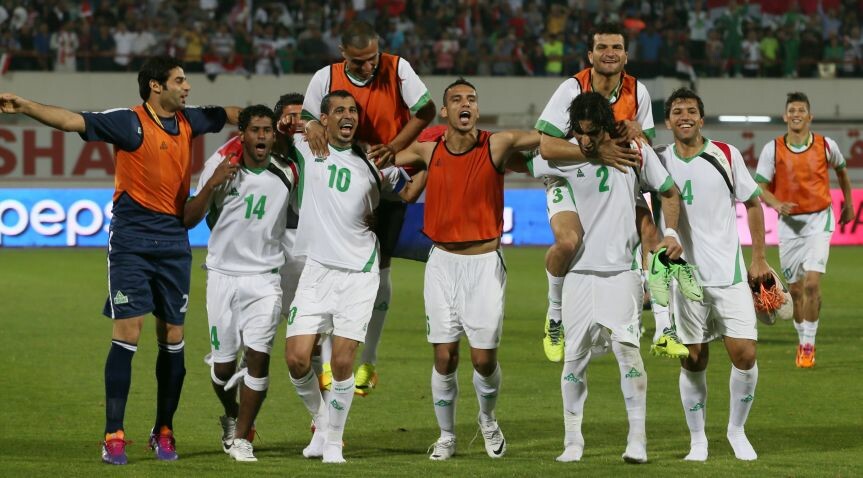
For the tournament itself, Obeid was working in Dubai as a television pundit and he was unable to contain himself when Younus Mahmood rose to head home the final’s only goal on 72 minutes.
“When Younus scored we jumped around the TV studio cheering. And when the show came on air they began by showing all the Iraqi people from all over the world celebrating,” says Obeid.
“Amongst the footage, I actually saw one friend in Jordan, who I hadn’t seen in 20 years, and that made me begin to cry on live TV because I was so happy and it was so great for the Iraqi people.
“Many Iraqis were in the UAE. too and when the team won the championship all the roads were blocked with their celebrations, so many people were so happy because it was the first time the Iraq team had won the Asian Cup.”
Iraq’s title defence four years later in Qatar ended at the quarter-final stage, their fourth such elimination, after a Harry Kewell goal deep into extra-time sent Australia through at their expense.
But with the finals in Australia now just a handful of months away, Obeid feels that should Iraq have any hope of re-creating the scintillating success story of 2007 much will depend on two key men: mercurial coach Hakeem Shakir and evergreen striker Mahmood.
“Many people call Hakeem Shakir, Iraq’s Mourinho. He is a very lucky coach. Lucky in terms of results, players and results in competitions so far,” says Obeid. “Even though the generation of players he has at his disposal is not better than the one in 2007, this side should be good enough to make the knockout stage; at least second place in the group.
“There are a lot of good players in the team but Younus Mahmood will continue to be the most important. He’s a very experienced player with over 100 international games now and he’s a very good player with a lot of strength.
“I do worry if the team plays against someone like Korea or Japan in the knockout stages, as these are very strong teams. But I think the chance of actually winning tournaments or cups is a lot down to luck, and, as I said, Shakir is a very lucky coach.”
Photo: AFP