
Thu, 28 Oct, 2021
When Al Ahli defender Kwong Kyung-won drove home a dramatic stoppage time winner against Saudi Arabia’s Al Hilal last month to take the Emirati side into their first-ever AFC Champions League final against China’s Guangzhou Evergrande, the Korean became the latest in a long line of East Asian players who have travelled West to find success on the other side of the continent, including the likes of AFC Champions League winners Kwak Tae-hwi, Lee Jung-soo and Matthew Spiranovic.
However, few have made the journey in the opposite direction, from West to East, as successfully as 1998 Asian Club Championship winner Abbas Obeid, a true pan-Asian pioneer whose transfer from Iraq to Korea Republic led to him netting a famous spot-kick that cemented his name in the continent’s footballing history.
Born to a poor family in the Iraqi capital of Baghdad in 1973, Obeid began the first steps in his career on the streets of the city as a seven-year-old before joining his first official club, Al Sinaa, in 1986 and helping them win promotion to the top-flight three years later.
Obeid then took in spells at three of Baghdad’s biggest clubs with Al Talaba, Al Zawraa and Al Qowa Al Jawia all employing the services of the tricky midfielder with an eye for goal.
However, while his name was becoming well-known in the capital, things were not well at home.
“The situation in Iraq was terrible during the 90s from the time Iraq occupied Kuwait until I moved. Food was scarce and very bad. Even football boots were rare; you could not afford such things on a small salary. If you gave a pair of football boots to a player back then, it was like giving him a house,” says Obeid.
“My family especially had a hard time as we were very poor. My father had retired from work; he was too old to continue. I got paid maybe US$3 each month and had to be the main breadwinner.”
Obeid’s life changed, though, in July 1995 when he stormed on to the international scene in the Merdeka Independence Anniversary Tournament in Kuala Lumpur.
Scoring on his Iraq debut in a 2-2 draw against Korea, Obeid was also on target against the hosts in a 2-1 win that grabbed the attention of on-looking Anyang Cheetahs’ assistant coach Pak Hung-suk, who would eventually sign both Obeid and countryman Sadiq Sadoun and bring them to the Korean top flight.
And while Sadoun left Anyang, a satellite city of Seoul, after one season, Obeid flourished on the field despite the initial cultural differences off it.
“I tried to eat Korean food, but it is too difficult for me,” recalls Obeid.
“The language was also a big problem. I spent one and a half years learning some words to use in the games, but there was no official Korean teacher to help.
“Korean football was very fast and I was surprised at first, but I had to adapt to learn how to be like a Korean player. The players and coach helped me to understand the style, and the Korean people are very sweet and nice to me.
“I got a lot more money, so I could send more home – my life changed 100% and I got a very good life when I moved to Korea. And now I speak Korean very well, better than English.”
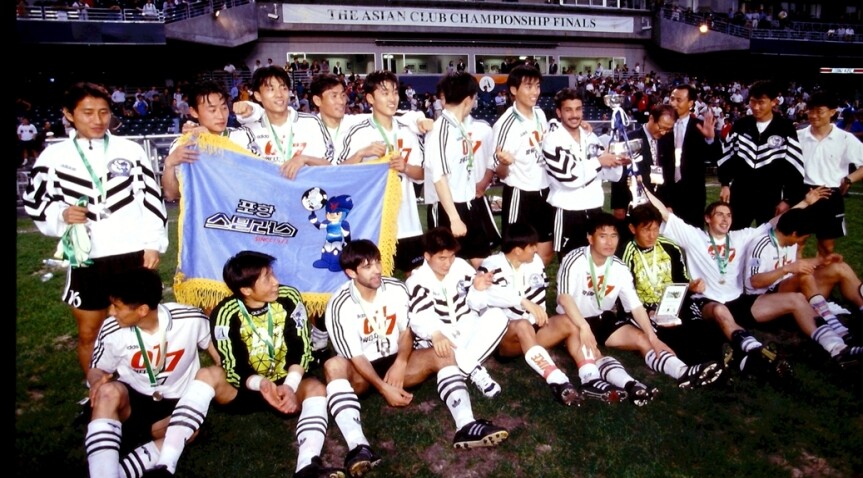
After two years at Anyang, Obeid signed for reigning Asian Club Championship winners Pohang Steelers (pictured) in July 1997 in time to join their campaign to retain their continental title.
Comfortable double digit victories over Bangladesh’s Mohammedan SC and Maldivian side Victory SC saw Pohang progress to February’s East Asia group stage in Zhejiang, China, and they topped a group that included hosts Dalian Wanda, Japan’s Kashima Antlers and Myanmar’s Finance and Revenue, to advance to the semi-finals in Hong Kong in April.
Pohang winger Park Tae-he’s goal was then enough to secure a 1-0 win over Al Hilal’s Saudi Arabia which set-up a re-match with Dalian in the final at Hong Kong Stadium.
Wang Tao and Hao Haidong both came close in a first half dominated by Dalian, but in a classic game of two halves, Pohang came out stronger after the break, with Park volleying just over.
But as the game neared full time, penalties looked more and more likely, with both sides looking tired in front of goal.
“What I remember from the final against Dalian is we played 120 minutes and then it came to penalty kicks – I hate penalty kicks, I didn’t want it to go to penalty kicks,” says Obeid, who started against Dalian.
“When you score a penalty everyone says, ‘Ah, it’s too easy, anyway’ but when you lose it the whole world is saying, ‘How can you miss? It’s so easy.’
“Anyway, the score went to 5-5 and I turned round and the coach looked at me and told me I was next. I felt like the coach had killed me.
“The Dalian player went up first, and he put the ball wide. I hated the pressure. But you have to be professional, the club signed you to help them – so if you miss a penalty in a shootout it’s a big problem.”
Obeid did initially miss after hitting the post, but after the referee ordered the kick to be re-taken, he made no mistake a second time, sending Dalian goalkeeper Han Wenhai the wrong way to win the shootout for Pohang.
“After scoring I took my shirt off and started running and the players ran after me, it was a very good feeling,” he recalls.
“Iraqi TV came to do a one hour programme on me and we were talking about this penalty kick; that Abbas scored this penalty and helped the Korean people.
“This was a very good chance to let the people outside of Iraq really know me, as it was the first chance to play in the Asian Club Championship.
“There are many people in the continent who know Abbas from this final.”
In the wake of his success overseas, Obeid became Iraq captain and led them to a perfect record in qualifying to reach the 2000 AFC Asian Cup in Lebanon, where he helped them to a quarter-final finish.
His Korean adventure ended in 2001 with a return to West Asia and a five-year spell at Bahrain SC before his retirement in 2007.
Obeid is now passing on his pan-Asian knowledge and experience to his nation’s next generation and was assistant coach for Iraq at last year’s AFC U-19 Championship.
Photo: WSG