
Thu, 28 Oct, 2021
Samurai Blue legend Hiroshi Nanami knows what it takes for continental success.
When Japan’s squad for the 2000 edition of the AFC Asian Cup arrived in Lebanon, Nanami was a man without a club, having completed a one-season stint with Serie A side Venezia the previous summer.
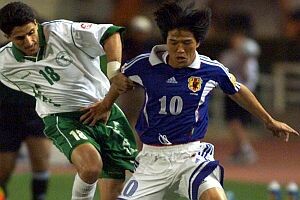
Few would have expected the former Jubilo Iwata midfielder to have finished the tournament not only with an AFC Asian Cup winners’ medal around his neck, but he walked away from the final in Beirut having been crowned the tournament’s Most Valuable Player.
The win capped a fine 18-month period at continental level for Nanami. In May 1999 he had been an integral part of the Jubilo team that defeated home side Esteghlal in Tehran’s imposing Azadi Stadium to capture the Asian Club Championship title.
At the AFC Asian Cup, he was lining up alongside a young group of players who would go on to form the core of the squad that reached the second round of the FIFA World Cup in 2002 under enigmatic Frenchman Philippe Troussier.
But it was the events that unfolded in Lebanon in 2000 which helped shape the destiny of that fledgling team, believes Nanami.
“Troussier often told us before the final of that AFC Asian Cup that if we win this match and the tournament that we are entitled to play in the FIFA Confederations Cup as the Asian champions,” says the former Japan midfielder.
“That means you can have the opportunity to play against the real powerhouses of Europe, like France, Germany or whoever, in the top 10 in the world. You will have that opportunity and you should be really proud to do so.
“If I look at the Asian Cup, then it was an asset for us to win that tournament. That helped us to face top 10 teams from around the world, not just once but on several occasions and that was what led to the results in 2002 at the World Cup.”
Japan’s march to the title started in impressive fashion as Troussier’s team handed Saudi Arabia a 4-1 defeat before thrashing Uzbekistan 8-1. A 1-1 draw with Qatar ensured Japan finished top of their group before another commanding performance in the quarter-finals saw the Japanese secure a 4-1 win over Iraq.
There were more goals in the semi-final as China were eliminated from the competition with the Japanese winning 3-2 before a second meeting with the Saudis, which ended 1-0 in favour of Nanami and his team-mates as Japan clinched their second continental title.
“I was a member of the squad in the United Arab Emirates in 1996 when Japan couldn’t really produce a good result in the quarter-finals (they lost to Kuwait) so because of that I was hoping that I could convey my experience to the youngsters and that they could grow throughout the tournament,” says Nanami.
“But they betrayed my expectations in a good way and in the first game against Saudi Arabia we had a complete victory over them, so it was a good start. Against Qatar we changed the team completely and allowed them to go ahead but we came back. Against Iraq it was the same but we kept a cool head and we did okay. Overall, I think that team grew throughout the course of the tournament.”
Players such as Junichi Inamoto, Shinji Ono and Shunsuke Nakamura experienced their first taste of continental success in Lebanon, but for Nanami the win followed Jubilo’s title win a year earlier.
And it was that success at club level that spurred him on towards victory with the national team in 2000.
“You cannot expect to win in Asia so often,” he says.
“It’s rarely a reality. In 1999 I won the Asian Club Championship with my club and that victory gave me the desire to go to the Asian Cup and really want to win it with the national team in Lebanon.
“Playing in Tehran was completely away from home, that was the biggest impression I had and the additional time in the second half seemed to last forever.
“Before that match in Tehran, I had some international experience with the national team and with my club but that match made me realise how important it is to have a good analysis of the opponents and get used to the environment where the game is to be played as well as the refereeing standard, all of those variations in conditions.
“If you can’t clear all of these hurdles then you can’t win a title in Asia.”
Eleven years on from Japan’s success at the 2000 AFC Asian Cup, Nanami remains proud of his achievement.
“That’s the biggest title I have and it makes me feel so proud,” he says.
“That is the reason why foreign members of the media come and ask me my opinions when I visit tournaments outside Japan.
“Even in Japan, the Japanese fans still speak to me about that Asian Cup and say it was really great. So all I have is a good impression.”