
Thu, 28 Oct, 2021
With the AFC's 60th Anniversary celebrations looming large on the horizon the-afc.com continues its series looking at the history and development of Member Associations by focussing on the All India Football Federation - one of the AFC's twelve founding members in 1954.
June 23, 1937 was to prove a momentous occasion for football in India.
When representatives met in Shimla some 77 years ago to form the All India Football Federation (AIFF) and appoint Brigadier VHB Mejendine as its first President, few could have predicted the bright future and meteoric rise in popularity that lay ahead for the sport in their own backyard.
After much heated debate and disagreement prior to the gathering in Himachel Pradesh's capital, the Indian Football Association (IFA), the Army Sports Control Board, United Provinces, Bihar, the North West India Football Association and Delhi, finally joined forces in a bid to show that strength in numbers was the only real way to progress football throughout the length and breadth of India.
Although things were clearly changing in the way football was governed, many were quick to acknowledge the sterling work the IFA had carried out prior to the AIFF's birth in 1937. Indeed, since its formation in the early 1890's the IFA had been in the vanguard of football development thanks to its de facto role as India's governing body.
After the horrors of World War II and Partition, the AIFF was eager not to be left behind on the world stage, and promptly became affiliated to FIFA in 1948.
In the same year, India competed at the London Olympics, Sarangapani Raman scoring his country's first goal at an international tournament as a predominantly barefooted side lost 2-1 to France.
With the legendary Syed Abdul Rahim as the helm, India then won the 1951 Asian Games which they hosted. Second place at the 1954 Asian Games quickly followed as did membership of the Asian Football Confederation - India joining Afghanistan, Chinese Taipei, Hong Kong, Indonesia, Japan, Korea Republic, Myanmar, Singapore Pakistan, the Philippines and Vietnam as one of the AFC's twelve founding Member Associations.
More success was to come courtesy of India's claiming of fourth spot at the 1958 Olympic Games, the highlight of which was Neville D'Souza's hat-trick in a 4-2 win against host nation Australia.
Another Asian Games triumph was masterminded in 1962 when legendary figures PK Banerjee and Jarnail Singh, amongst others, excelled for their country. Two years later, India sensationally finished second at the AFC Asian Cup, where they lost 2-0 to both Korea Republic and Israel but beat Hong Kong 3-1.
An admittedly fallow period ensued, although India's international inertia was eventually shaken off when they qualified for the AFC Asian Cup in 1984, before the first of the country's six South Asian Football Federation Championship titles was claimed in 1993.
Victory for the Under-23 team at the 2002 LG Cup in Vietnam, and the national team's capture of the 2007 Nehru Cup trophy, then provided proof positive that India, with the AIFF nurturing every step of the way, was once again moving in the right direction.
That train of thought was duly reinforced by India's winning of the AFC Challenge Cup in 2008, a victory which earned coach Bob Hougton's side a place at the AFC Asian Cup 2011 in Qatar where they received plaudits galore despite losing all of their three group games.
Domestically, football in India has shone just as brightly.
From the world's third oldest football tournament in the shape of the Durand Cup, to the ever popular I-League via its predecessor the National Football League, the progress of football within India's shores still shows no sign of abating.
In fact, with sides from India now competing regularly in both the AFC Champions League and AFC Cup competitions - Pune FC and Churchill Brothers were involved this season - the belief that Indian clubs will, in time and under the wily guidance of the AIFF, become true Asian powerhouses is slowly but surely gaining credence.
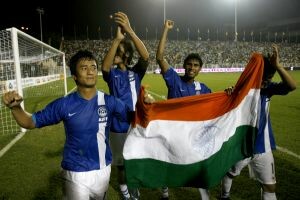
These ever improving standards within India have also helped further raise the nation's profile internationally thanks to the export of local talent - Baichung Bhutia (pictured) and Sunil Chhetri fine examples of players who taken their own particular brand of football to foreign climes.
While the triumphs of Bhutia and Chhetri may only represent a couple of landmarks in the fascinating growth of Indian football, there can be little doubt that the beautiful game in this populous nation has come on leaps and bounds since 1937.
Thankfully for all those concerned, there is plenty to suggest that under the current stewardship of President Praful Patel, progress will continue to be made by both the AIFF and the football it governs.
Photo: AFP