
FIFA World Cup
The 17th edition of the global showpiece was also the first to be co-hosted as Japan and Korea Republic joined forces to deliver a festival of football in which they both excelled, with the Taeguk Warriors producing a remarkable run to the semi-finals.
There was also a first and, to date, only appearance from China PR, while Saudi Arabia returned for a third successive time.
Taeguk Warriors create history
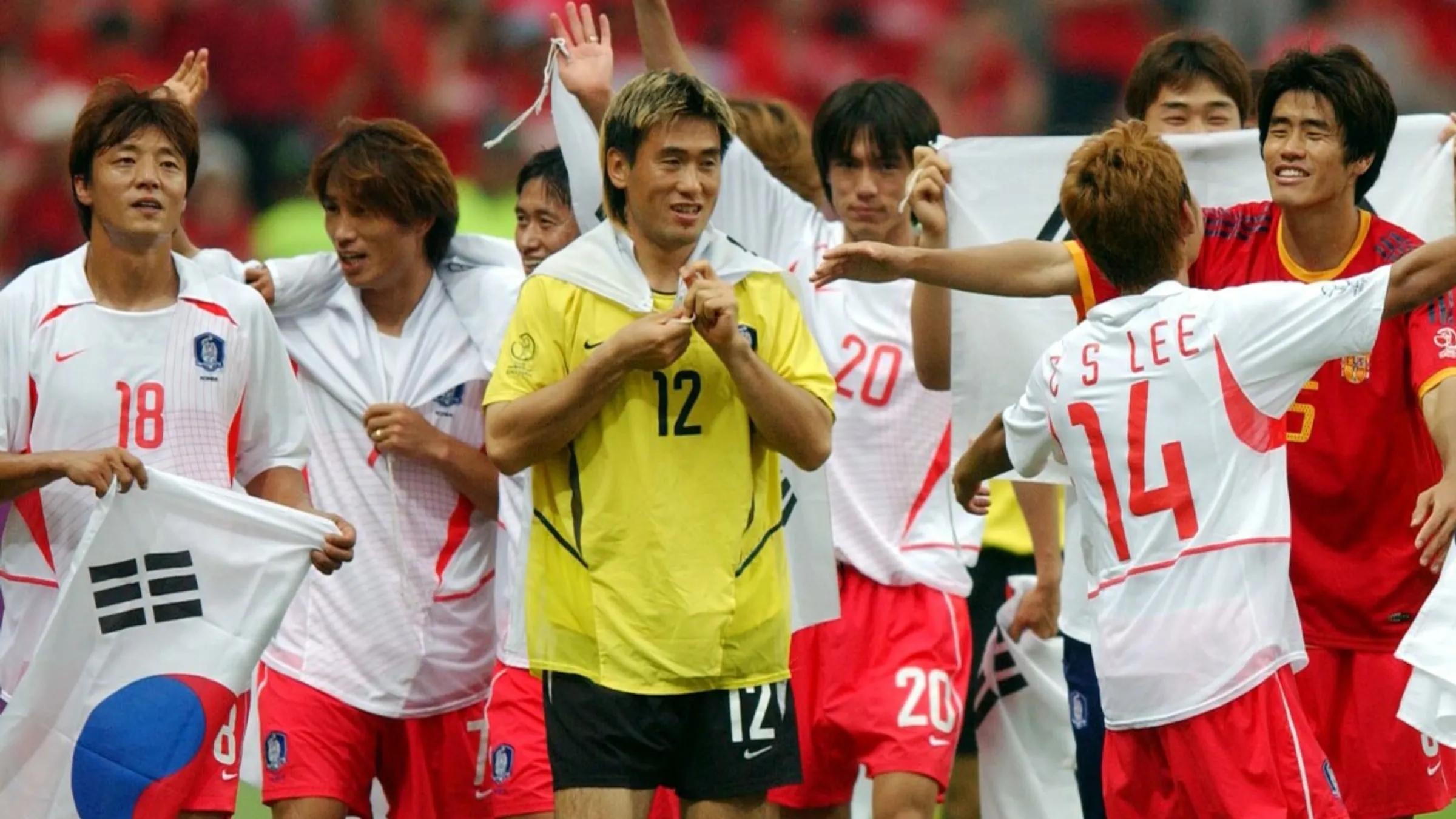
Under Dutch head coach Guus Hiddink, Korea Republic’s players ensured they would be forever remembered as legends following a campaign that saw them come within a game of the final in a march to the semi-finals that remains among the biggest shocks in the tournament’s history.
Under Dutch head coach Guus Hiddink, Korea Republic’s players ensured they would be forever remembered as legends following a campaign that saw them come within a game of the final in a march to the semi-finals that remains among the biggest shocks in the tournament’s history.
The Taeguk Warriors got off to the perfect start against Poland in Busan when Hwang Sun-hong swept home Lee Eul-yong’s cross from the left to open the scoring in the 26th minute with his 50th – and final – international goal before Yoo Sang-chul fired in from distance early in the second half to send the home support in raptures as Korea secured a first-ever FIFA World Cup victory.
Hiddink’s side fell behind midway through the first half of their second Group D match against the United States in Daegu but secured a valuable point when Ahn Jung-hwan headed home an equaliser with 12 minutes to play to ensure they went into their final group game against a Portugal side featuring Luis Figo on top of the standings.
And spurred on by more than 50,000 spectators in Incheon, the Koreans delivered once more when, with 20 minutes to play, Park Ji-sung controlled Lee Young-pyo’s cross from the left on his chest, cut inside Sergio Conceicao and rifled a left-footed effort past Vitor Baia in the Portugal goal to secure a 1-0 win and a first-ever qualification to the knockout rounds.
The mighty Italians awaited in the Round of 16 in Daejeon and Korea spurned an early opportunity to take the lead when Ahn saw his penalty saved by Gianluigi Buffon before Christian Vieri headed Italy in front in the 18th minute. But what followed was remarkable as, with three minutes to play, Seol Ki-hyeon took advantage of some poor defending to equalise and then, with the Azzurri down to 10 men, Ahn made amends for his earlier miss by heading in a golden goal with three minutes of extra-time remaining to spark pandemonium all around as Korea advanced.
Next up came Spain in Gwangju in a quarter-final that saw plenty of action but no goals with Park, Lee Chun-soo and Hwang all missing chances for the Koreans and the Spaniards hitting the woodwork. In the end, it came down to penalties and the Taeguk Warriors held their nerve, netting five from five with current head coach Hong Myung-bo striking the decisive spot-kick after Joaquin’s effort was saved by Lee Woon-jae as Korea became the first Asian side to ever reach a FIFA World Cup semi-final.
A sea of red at Seoul World Cup Stadium greeted the Taeguk Warriors ahead of their semi-final with Germany as they sought yet another heroic effort. But it was in the Korean capital where the dream was ended as, after a goalless first half, Michael Ballack finished at the second attempt following Woon’s initial save to strike the only goal of the game and break the hearts of a nation.
Back in Daegu for the third-place playoff against Turkey, Korea Republic were given a hero’s welcome as they entered the fray. Lee Eul-yong briefly drew the hosts level with a stunning free-kick after they had fallen behind but Turkey were 3-1 up by the interval. While Korea were unable to force their way back into the game, it was perhaps fitting that they gave their supporters one last moment to cheer when Song Chong-gug’s effort from distance found its way past Rustu Recber in the Turkish goal as the game ended 3-2.
Some 24 years on, Korea’s performance under the masterful Hiddink remains one of the most unlikely stories in FIFA World Cup history as the hosts who many had tipped to fall at the first hurdle came within a game of the biggest match in world football.
Samurai Blue break new ground
Co-hosts Japan were appearing in their second successive FIFA World Cup having debuted in France four years earlier and, under French tactician Philippe Troussier, the East Asians gave the world a glimpse of just how far football had come in the East Asian nation.
Co-hosts Japan were appearing in their second successive FIFA World Cup having debuted in France four years earlier and, under French tactician Philippe Troussier, the East Asians gave the world a glimpse of just how far football had come in the East Asian nation.
Marc Wilmots’ spectacular overhead kick put Belgium in front just before the hour in their Group H opener but Takayuki Suzuki sparked wild celebrations around Saitama Stadium when he levelled soon after before Junichi Inamoto broke into the box and rifled the Japanese in front in the 67th minute to put the hosts on the verge of a maiden FIFA World Cup victory. Belgium levelled with 15 minutes to play but a first-ever point at the global showpiece was a sign of things to come.
And Japan did not have to wait long for their first win when, three days later in Yokohama, Inamoto struck once more. Koji Nakata’s cross from the left in the 51st minute was expertly laid off by Atsushi Yanagisawa and Inamoto took one touch before finishing with aplomb as the home side claimed all three points.
In a congested group there remained plenty to do ahead of their final game against Tunisia, but brimming with confidence and with a nation swept away in FIFA World Cup fever, the Samurai Blue turned on the style. Hiroaki Morishima fired the hosts in front shortly after the interval in Osaka and their star man, Hidetoshi Nakata, made sure of the win, heading home Daisuke Ichikawa’s cross from the right to send Japan into the knockout rounds as table-toppers.
Troussier’s side faced Turkey at a saturated Miyagi Stadium with a place in the quarter-finals on the line. But it was the visitors who went in front in the 12th minute when Ergun Penbe’s inswinging corner was headed home by Umit Davala.
Japan chased an equaliser and were desperately unlucky not to find one when Alex’s delightful free-kick came back off the woodwork after Recber was well beaten. Akinori Nishizawa fired just over in the second half but the Turkish backline held firm as they kept the Samurai Blue at bay to progress to the last eight.
But the campaign would go down as a huge success for Japan, who, having only reached the tournament for the first time four years earlier, had – along with Korea Republic – become the third and fourth Asian nations to advance to the knockout rounds.
China PR make debut appearance
Having topped their qualifying group with ease, China PR had written their own piece of history by advancing to a FIFA World Cup for the very first time.
Having topped their qualifying group with ease, China PR had written their own piece of history by advancing to a FIFA World Cup for the very first time.
Under Serbian head coach Bora Milutinovic, who had previously guided Mexico (1986), Costa Rica (1990), the United States (1994) and Nigeria (1998) into the knockout rounds, the Chinese had one of the most experienced tacticians in world football at their helm.
And their squad was brimming with talent, with Sun Jihai, Fan Zhiyi, Ma Mingyu and Li Tie all part of a line-up that had been paired with four-time world champions Brazil, Turkey and Milutinovic’s former side Costa Rica.
Yang Chen blazed an effort wide early in the second half of their opener against the Costa Ricans, who then went ahead just after the hour through Ronald Gomez before Wilber Wright headed home soon after to hand the Central Americans a 2-0 win.
A star-studded Brazil came next and the Selecao brought their A-listers to the party as Roberto Carlos thumped in an early free-kick before goals from Rivaldo, Ronaldinho and Ronaldo saw the South American side, who would go on to lift the trophy, claim a resounding 4-0 win.
Eliminated before their third and final game against Turkey, China PR were still chasing a first point and a first goal ahead of the clash. But it was not to be as, two down inside 10 minutes, they succumbed to a 3-0 loss and exited from what remains their only appearance on the biggest stage.
Tough outing for Saudi Arabia
Having picked up a single point in France four years earlier, Saudi Arabia were hopeful of a better showing at the first-ever World Cup on Asian soil, but against the powerful Germany, African champions Cameroon and the Republic of Ireland, it was a difficult draw for the Green Falcons.
Having picked up a single point in France four years earlier, Saudi Arabia were hopeful of a better showing at the first-ever World Cup on Asian soil, but against the powerful Germany, African champions Cameroon and the Republic of Ireland, it was a difficult draw for the Green Falcons.
Opening their campaign in Sapporo, they were faced by a team that would go on to reach the final, and a striker who would in years to come be known as the FIFA World Cup’s all-time top scorer. Miroslav Klose netted a hat-trick as Saudi Arabia were dealt the heaviest defeat for any Asian side in the competition’s history, losing 8-0.
The second game against Cameroon in Saitama was closely contested. Only a second-half Samuel Eto’o strike separated the two sides at the final whistle.
With early elimination confirmed, Nasser Al Johar’s side succumbed to a 3-0 defeat against the Republic of Ireland.
The second game against Cameroon in Saitama was closely contested. Only a second-half Samuel Eto’o strike separated the two sides at the final whistle.
With early elimination confirmed, Nasser Al Johar’s side succumbed to a 3-0 defeat against the Republic of Ireland.
